


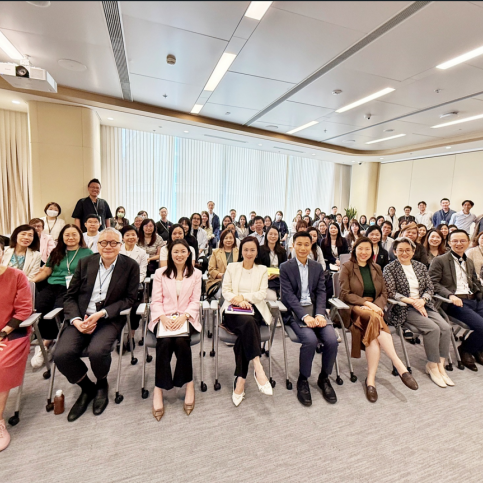
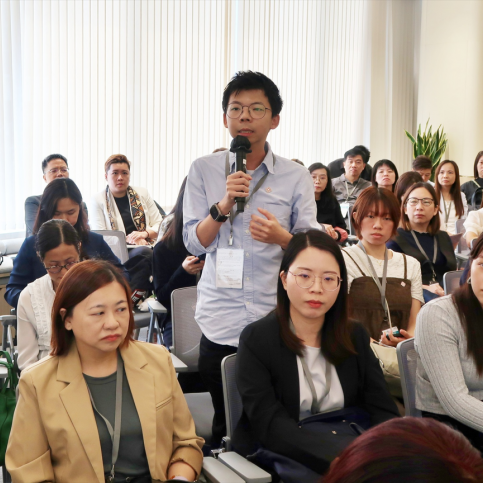
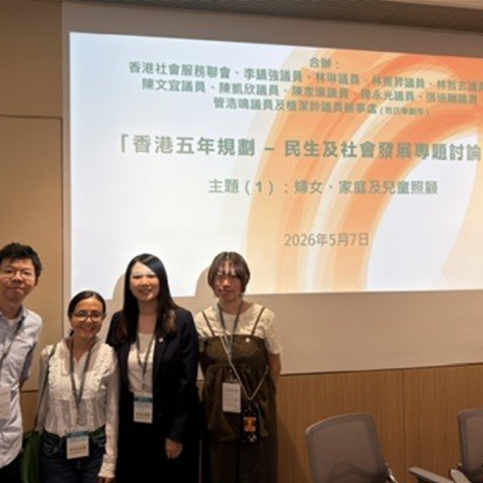
The Hong Kong SAR Government is actively formulating its first five-year plan, aiming to establish a clearer policy blueprint for socio-economic development and public welfare over the next five years. Recently, the Hong Kong Council of Social Service, together with Legislative Council members Ir Hon LEE Chun-keung, Hon Nixie LAM Lam, Hon LAM Chun-sing, Dr Hon David LAM Tzit-yuen, Hon Grace CHAN Man-yee, Hon CHAN Hoi-yan, Hon Judy CHAN Kapui, Prof Hon CHAN Wing-kwong, Hon CHEUNG Pui-kong, Revd Canon Hon Peter Douglas KOON Ho-ming, and Hon Elaine CHIK Kit-ling (and their offices), jointly organized the “Hong Kong Five-Year Plan – Thematic Discussion on Livelihood and Welfare” to gather views from the sector and the public on various welfare-related issues.
Development Team and Ms. Pamela Knight, Officer-in-charge of the Jockey Club Wah Fu Centre, attended the discussion and participated in exchanges on the theme of “Women, Family, and Child Care.”
At the meeting, Mr. Alvin Chung, Officer-in-charge of the Development Team, shared recommendations for Hong Kong’s Five-Year Plan. He expressed hope that frontline service experience, along with the real needs of women, families, children, and caregivers, will be incorporated into future policy planning, with a long-term goal of promoting women’s development and building a caregiver-friendly society.
???? Continuous Updates to Women’s Statistics in Hong Kong
Comprehensive and regularly updated gender-disaggregated data are crucial for social service planning and policymaking. Such data enable the government and stakeholders to understand changes and needs of women in areas such as employment, caregiving, health, and economic participation, facilitating more precise and evidence-based welfare policies. Data-driven policy design can better address the needs of different groups of women at various life stages, align with the direction of “high-quality development,” and provide more appropriate support and development opportunities for women in the family, workplace, and wider society.
???? Promoting Life Planning for Caregivers
Current caregiver services mainly focus on immediate support and relief needs. Looking ahead, there is scope to shift toward a “development-oriented” approach—helping caregivers rediscover personal interests and potential, and transforming their caregiving experiences into a “second life” development pathway. Such initiatives can also align with Hong Kong’s aging population trend, promoting a caregiver- and family-friendly society while unlocking women’s labour force and social participation potential.
???? Addressing Psychological Abuse and Coercive Control
Based on frontline experience from our hotline services, approximately 60% to 80% of domestic violence help-seeking cases over the past five years have involved psychological abuse. In the long term, we recommend drawing reference from legal reforms in jurisdictions such as the United Kingdom and Australia to explore including “controlling or coercive behaviour” within the scope of criminal regulation, thereby strengthening protection for victims and promoting family well-being and social stability.
Hong Kong’s first five-year plan should not only focus on economic development, but also respond to genuine social needs. The situations and needs of women, families, and caregivers must form a vital part of the plan. Through more forward-looking and people-centered policy design, Hong Kong can both integrate into broader development strategies and build a more resilient and caring public welfare system.