


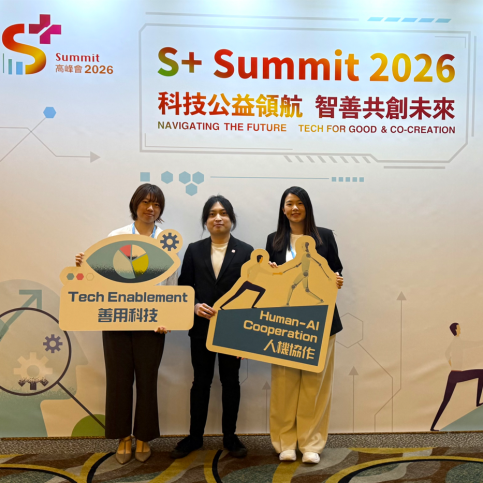
Our Development Team participated in the “S+ Summit 2026: Navigating the Future – Tech for Good & Co-creation”, organised by the Hong Kong Council of Social Service. Together with different stakeholders, we explored the possibilities of artificial intelligence, big data, and the future development of social services.
Hong Kong is undergoing rapid changes. Shifts in population structure, the economic environment, and climate change are bringing new challenges to society, while technological advancement is also opening up new space for service innovation in the social welfare sector. The Summit was highly inspiring and encouraged us to reflect on how AI and data can be better utilised to enhance volunteer matching, improve colleagues’ efficiency in daily work, and foster collaboration across different sectors.
Technological development is not only about upgrading tools. It also requires us to pay attention to the different needs and experiences of people across gender, age, caregiving roles, and socio-economic backgrounds when using technology. For women, carers, young people, and grassroots communities to truly benefit from AI and digital services, accessibility, participation opportunities, and user experience must be considered throughout the design process, so that technological progress does not further widen existing inequalities.
The wider adoption of AI also reminds us that the future development of services is not only about the use of tools, but also about how people grow alongside technology. In particular, in youth development and community participation, the effective use of AI for learning, creativity, and problem-solving can open up more possibilities. Although the rapid development of AI has led many sectors to reconsider the changing roles of people and technology, we believe that in the social welfare sector—where services are people-centred, compassionate, and innovation-driven—the value of technology lies in supporting, connecting, and empowering people.
Moving forward, we will continue to adopt a gender-sensitive and women-centred perspective, learn to make better use of digital technology, and promote service innovation and knowledge management. Through continuous learning and adaptation, we hope to better respond to the needs of different communities and service users.